Thursday, December 5, 2013

Inheritance, Italian Style


What do we leave our children? 

We hear much lately that our children’s generation will be the first whose quality of life will be lower than the previous.  This is increasingly the case in the US and with the struggles now in Italy, that is the trajectory that is underway.

In relative terms, life expectancy in the US is headed down(we sit at 26th overall worldwide), yet we spend more on healthcare than the rest of the world combined.  Unemployment amongst the Italian youth is roughly 40%.  The recent study on education showed that we lag behind much of the world.  So, as a man of certain age, I begin to think about what we have done.

We have borrowed and consumed our way to something that is really not that attractive.  And now, we read about our Millennial generation are the most depressed generation ever.  Our kids have little coping skills to deal with the complexity that we find ourselves in. 

So what does that have to do with our village?  Some may think we are only restoring Veglio so we can wander in the vineyard in our later years like some Corleone on the hideout.  But that is not the case.  We believe there are lessons to be taught, that must be taught if we are to do our job as the generation that is now looking over the horizon. 

Our “curriculum” will take many forms but here are the thoughts that guide us…

Family, community and the table must be at the center of society.   We have found ourselves dispersed away from our traditional communities and families.  We were taught that success meant following your job no matter the cost.  And the fabric that held together families together unraveled especially in the face of divorce and aging parents. 

And while we grasp at online communities and work as replacements, there is no substitute for families around the table sharing stories, challenges and hopes.  
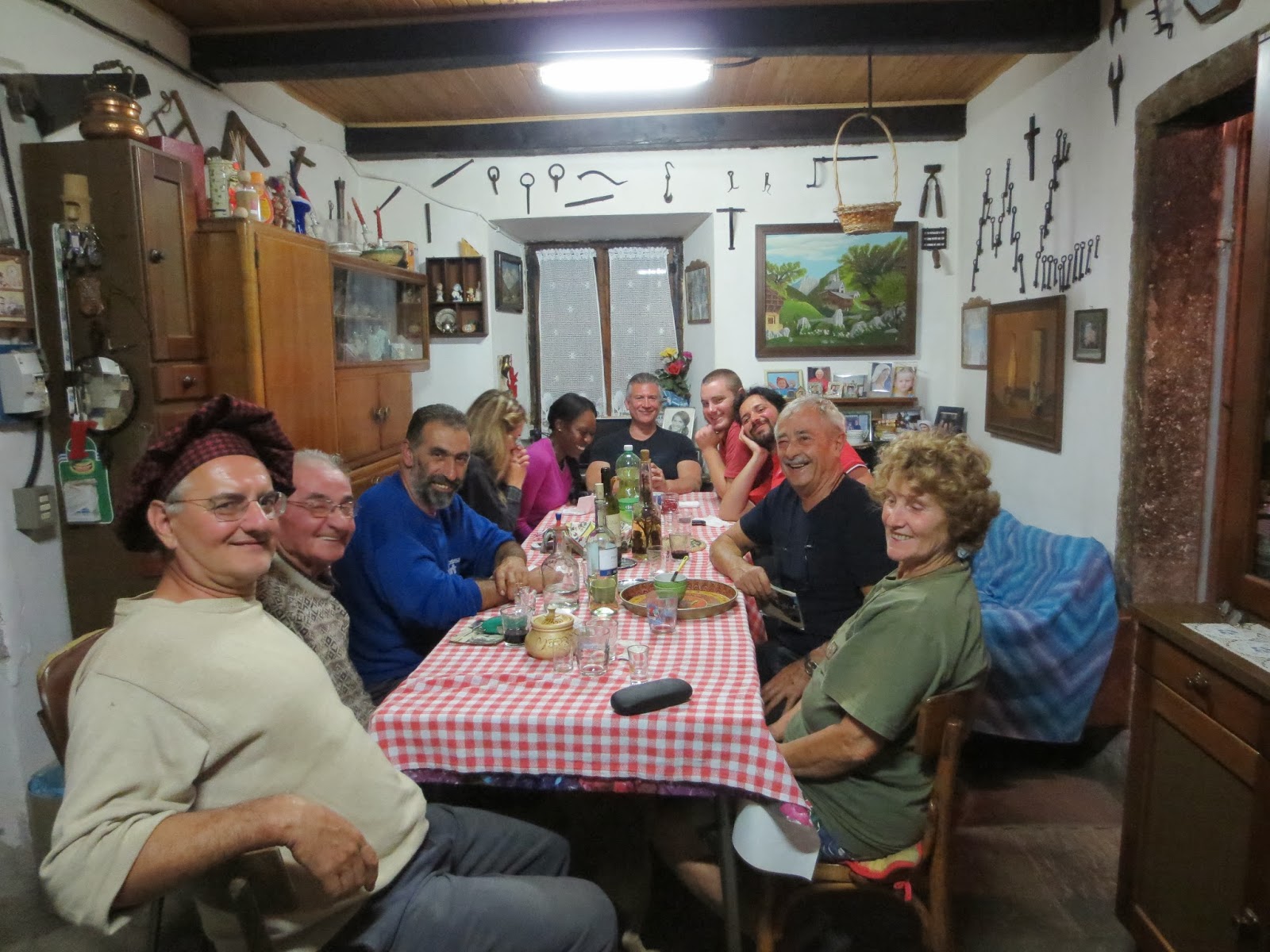
We dream of our village as a place where family can always gather.  To spend time working together, telling stories, sharing sadness and joy but also coming together.  We also home that this “family” extends to our friends who share the appreciation for the simple joy of a good meal, hard work and good conversation.

The connection to the earth is essential to grounding us.  I read once somewhere that you are supposed to stand in bare feet in the dirt at least 12 minutes per day.  Somehow that is somehow reconnecting us to mother earth.  Well, I am not sure about that but I do know that surrounding yourself with trees and rocks and gardens with rich, clean soil is soul and body enriching experience.

We are now acutely aware of the benefits of local agriculture, clean and slow food and its preparation.  We have expanded our original land in Veglio to include new areas of farmland and also forest.  With the help of willing college students, we hope to begin the process of reclaiming the fields that have been overgrown over the past 50 years.

Yes, those are cows on the bridge
The forest will give us the wood that will be used to fuel all of the heat for our home including hot water.  We will have some emergency electric heat and propane, but as designed there are two large fireplaces, three wood stoves, the cooking stove that also provides hot water and then a wood fired hot water heater.

And we hope that time in the Village learning to garden and respect the land will translate back home.  More food on your own patch of land, maybe a few chickens and resisting the urge for the overprocessed.

Our ancestors are with us to teach us.  We don’t like to talk about death in our modern culture.  We worship new, young and fast.  But that completely ignores all of the love, hard work and learnings that have come before us.  In Veglio, we have likely 30 generations of our family history.  Our hope is that we can celebrate and learn from them but also reconsider how we are able to learn from the cultures of all parts of our family tree.  The Yupik Eskimo,  the Portuguese, the Irish, the Arabic. 

We will surround ourselves with pictures and furniture and recipes and crafts of our extended family and the ancestors that are somewhere.   And we hope that the stories and lessons will somehow be preserved.

Chouinard at Work
Learning to work with our hands in resourceful ways gives creative problem solving.   We have forgotten how to think about the practical, physical parts of our lives.  How to measure, fit, draw, lift, twist and cut.  We have deferred much of those things in search for “real work”.  With the loss of those skills inside and outside our houses, we have lost some of our imagination.

One of the most widely recognized business leader is the CEO of Patagonia, Yvon Chouinard.  He started his company with his hands in the blacksmith shop and today it is a $600 million firm.  He insists on each of his managers spending time in the shop to think about the physical process.  How to design and improve and not just how to find cheaper, faster ways.

The remoteness of our village and the ancient approach to the construction gives us an incredible opportunity to relearn practical skills.  We envision a summer school where these crafts can be taught, both for people interested in making a career of them but also for our family and other people who may want to incorporate them into everyday life.s
Finally, after 700 years...A SEPTIC TANK

Live simply to thrive in a complex world.  We do live in very difficult, complex times.  The predictable corporate path is no longer predictable and our children’s generation is struggling to make sense of a world where the old rules are broken.  I don’t know the answers but I do know saddling yourself with debt, divorce and jobs that choke the creativity and flexibility set you up for the trap. 

Complex times require agility and the ability to adapt.  Packing a huge burden, both financially and relationally is very difficult.    So once again, we hope that a life of growing some of your own food,  building with your own hands and putting family and friends at the middle not the edge will be our most important inheritance to leave. 

Wednesday, October 9, 2013

OK, so now what!?


So, what are you going to do with the rest of your life?  How many times have we told that to our kids or heard others ask young people around us?  For Linda and me, the question just got a lot louder.

Uncle Chuck through the eyes and lens of Linda
Maybe a little background is in order.  Linda has been unable to continue her work in the dental field due to a neck injury.  She has been on a mission the past 18 months to study nutrition and holistic health with the goal of being a health coach.  Linda is  passionate about health and organic food and a sustainable life. She is also an accomplished photographer and shares my love of travel and new cultures.

For me, I have had a dream to live a more flexible, significant life for a while.  To teach and coach executives, invest in interesting innovative companies and to also create a more sustainable world in our sphere of influence.

AND, we want to live, teach,  cook, study, share our summers in Veglio and travel through Europe.
Two of the towers added this Summer

Sounds good but at the same time, I have been on a tread mill job for a very large multinational three letter firm.  In many ways, this job was a self imposed hurdle to driving through the unknown of creating the work and life that we both long for.

So, this past week, I made the decision to leave the corporate job behind and to go boldly in the direction of our dreams.  And together with Linda, Alexandra, Kurtis and Alexis, we are answering the question:  What are you going to do with the rest of your life?


Linda and I are now on to the business of creating our new businesses.  And to find out how we are going to be able to spend two months a year in our little village.   Oh and did I say that I sold my cherished 911 Carrera S!  Simplifying our lives must be more than a theory, so our German friend found a new home….to be likely replaced by a old 4x4 Fiat that we can putter around in while we are in Italy. 

So we take another step in our Journey to Veglio. 

Wednesday, May 29, 2013

Crossing the Bridge


We have been home for four days and our minds and bodies are just now shaking off the effects of the trip.  These are not only the inevitable jet lag that comes from nine hours of time change but also the abrupt change in our surroundings.

It is always a mind blowing, soul numbing transition as we move from Orange County to the mountain and back again.

Tissy starting the dishwasher
One moment we are watching plumped up Newporters pushing shih tzus in strollers and the next we are fetching our water from the fountain to wash the dishes.  This is both the appeal of our little village and also the thing that creates doubts in our minds. 

This trip especially we struggled going in with many questions on how we could balance our lives and achieve the dream of living part of the year on the mountain and building this bridge between two distinct cultures.

We are now officially two years into our “project” and the novelty of the idea is wearing off.  The “investment” so far has been five trips, the purchase, continued withdrawals from our savings for materials, one broken shoulder and more than a few late night conversations.   

Our estimated time and cost to completion, while more accurate than last year at this time, is still a very general range.  Not the kind of thing that 50-somethings like us enjoy as we plan for our last big push of work before some form of retirement. 

On this trip, our  imported work crew consisted of Linda, her sister Tissy, my brother Ken and family friend Sam Pontillo who is 18 and just finished his first year of college. 

By the time we landed in Milan, we were tired and the excitement of the trip was mixed with more than a few questions in our minds.  Could we complete the project without affecting our retirement?  Would our family want to visit us in the future half way around the world? Could we really build a little tourism business that would work?  Were we up to the physical challenge this type of construction requires? 
Isole Bella, Lago Maggiore

We piled into our little Fiat and began to make our way north in the intermittent drizzle that was giving way to heavier rain.  The plains around Milan quickly gave way to the hills that become mountains leading to the Alps.  Snow was covering many of the middle peaks from the late Spring.  We decided to stop at Stresa which is a town on the Lago Maggiore, one of the deep Alpine Lakes that on the way to Veglio. 

A few cappuccinos and a walk through the farmers market started to change our attitude. We arrived at our temporary home in Canova and settled in.

As the week unfolded, we were once again smitten.  The beauty of the land, the warmth of the people.  The enthusiasm that is building from the locals as they see the potential beginning to unfold. 

Our work crew when we are not there consists of Andrea and two other local people. The work must fit between Andrea’s day job in Switzerland and also the weather that is quite wet in Spring as the moist Mediterranean air meets the immense wall of the Alps that are over 12,000 feet in this part of Italy.

Our visits provide a much needed boost of energy and labor that helps the project maintain momentum.  On this trip, we wanted to first and foremost confirm the layout of the final designs of the rooms.  In addition, we wanted to complete the last small sections of wall and tower, dig out the water and sewer lines and place the large roof beams.

Andrea and Sam awaiting "cemento" buckets
Despite three days of very hard rain and very sore backs, we pushed on with the tasks.  Good fortune of the rocks in the just the right places and the herculean efforts of Piero accelerated our work ahead of schedule.

By week’s end, we had reached all of our goals and also opened up two new doorways, cleared the creek, cleaned out the old bread oven and continued the demolition of the old interior plaster. 

Standing back on the final day of work, the old house began to reflect its transformation.  We could clearly see the flow of the rooms, the placement of the windows, the stairs and layout of the kitchen.  No longer was it just a dripping pile of rock and rotted beams, but actually began to look like a stone home that could be brought to life with the sounds of children’s voices, cooking and music. 

Every successful project has a tipping point when the trough of disillusionment makes way to the confidence of completion.  While we will have many difficult moments, both Linda and I now can feel that this dream will be possible. 

The last section of stone on the tower
We also continue to learn that our work is not just about the stone and mortar, but about the opportunity to bring people together to live and learn.  Italians and Americans, young and old, city dwellers and farmers. 

This was most evident during our last dinner on the mountain this trip.  We decided to throw a little pizza party for our family and also many of those who are working on the project and in the village.   Since Papa John’s does not deliver in Veglio, we had to come up with Plan B. 

Pizza maker, Arrianna and Sam
There are three ancient ovens in Veglio.  The largest and newest is about two hundred years old. It is in good shape and is about 8 feet across. Historically, it served to make bread for much of the village for the entire week.  Likely several hundred loaves over a 8 hour baking time.

We decided to clean it out and fire it, which was last heated about five years ago.  The heat was immense and I burned the top of my hair and both Sam and I have fewer eyelashes that when we started.

Smiles all around
It was well worth the risk.  We made ten pizzas and served them around the table in the old house.  Even though just a few words of common language were shared amongst many, the visible smiles and raised glasses signified success.  Crazy Americans bringing pizza to the Italians but we hope much more. 

We are hopeful that we can continue to bring that most American of values, optimism and a can-do spirit to this village that continues to teach us so much.  

Saturday, October 20, 2012

The Nobility of Work


The first time that my Italian nephew Andrea met my American nephew Harry, he asked him a question.  Harry, what do you build?  Not Harry, what do you drive,  how many facebook friends do you have, what do you do…but what is it that you build with your own hands?  Harry, who is a hard working, wonderful young man was taken aback.  He had probably never been asked such a question.  It seems that in the modern American version of success, we have risen about working with our hands. 

Andrea and Harry Enjoying a Well Deserved Rest
That somehow those Powerpoints or spreadsheets are the real work and that to get the soil under our fingers or the sawdust on our brow is beneath us.  I think on some level, this is a reflection of our greater economic challenges where we got so successful and could borrow so easily that we deferred the making of and the building of and the designing of to others.  Affluenza I think they call it! 

In the old village of Veglio that at its peak had 250 inhabitants, nearly everything that was needed was made by hand.  The milk that was turned into cheese, the grapes that were turned into wine...the vegetables and animals to last through the winter.  The grain and chestnuts milled and then crafted into dark, nutritious bread that was baked twice a week. 

The rocks that were gathered  from the fields and the mountainsides were crafted into the walls and the roof.  The larch and pine and chestnut trees became the floors, the beams and the furniture.  Everything had a purpose and the wise use of your hands could turn the land and resources into the essential things that are required for a good life.

Mama Tuna and Grandpa and Grandma McCoy
I firmly believe that this somehow connects us to the earth and as importantly to each other.  Working together to provide the most important elements of our life.  There is a huge movement across the US to put on the table what is grown on small, local farms.  Thousands of young people who only in the previous generation would have been mocked for doing so, are opting out of the corporate track to build productive, healthy family farms.   
Grandma Driving Her SUV

A similar appreciation is growing of building with more sustainable, readily available materials.  Less plastic, less concrete, less material that must be trucked from halfway around the world.   We collectively seem to be gravitating, if ever so slowly,  towards a place of balance between convenience and significance. 

My grandparents had a huge influence on my life.  They not only loved me but they taught me how to work and how to appreciate the simple joys that come from making a house and land a home.  I have fond memories of my then 75 year old grandmother plowing her garden or replacing the floor of her porch.  We saw the same thing in the rural parts of Italy as well.   People well into their 80’s with shovels and rakes, working their garden or cleaning up a patch of land.  With smiles and a sense of contentment on their faces. 


Andrea and Sal Using a 700 Year Old Technique
My hope that this will be not only part of our life as we continue to restore our Italian home, but also will be a legacy that we can leave for our children and grandchildren. That they can learn to tend the gardens, grapes and the orchards. To cut the brush from the creek so they too can see the old church from the terrace on a late Summer day.  And also learn the ancient crafts and share the same experience as their ancestors three hundred years earlier. 

Dinner in Veglio
To get a sense of the satisfaction that comes from turning your labor into a meal for your family or a glass of wine that can be shared with friends around a fire.  To experience this on the mountain for a few weeks during the year and then bring that back to their own homes wherever that may be.


Monday, June 18, 2012

Making a home on the mountain


It is has been a month and a week since we got back from our trip to Veglio.  It seems like ten years since we were there but at the same time, I have images in my head during each day in which we are still there. 

We had an unusual trip in some respects if we look through the lense of a traditional vacation, but in other respects it was a very good, meaningful visit.  It was our first steps towards being at home in the Valley. And being at home means that problems exist in every day and in every family.  But at the same time, it means that we are home in a familiar, comforting place that allows us to sink roots.

Being home sometimes means you spend days cleaning up things you would rather not clean up.  On this particular trip, we had both of my brothers, Linda, Jocelyn, our daughter Alex, Mark’s daughter Allyssa and Ken’s niece Shandley.  We arrived on a Friday and settled into Mario’s place down the hill in Oira. The plan was for a good, reconnecting dinner at the restaurant next door and then an early night to rest and hit the village first thing in the morning.

Late Spring Rain and a Full Creek
We woke up to the sounds of light rain coming through the valley.  Our first order of business was to clean out the parts of the property that had been long neglected or used for livestock “storage” which was code for old hay and manure from various species.  That meant one group, largely Ken and Allyssa took the rabbit merde in the upper room while the rest of us cleaned out the various cellars and other stables that were needed for temporary storage.  Every one of us had very mucky tasks that were made even messier by the constant drip of the late Spring rain as the clouds had gathered against the Alps. 

Just about the time we finished with the nasty tasks, Andrea came up with the plan to move some items that had been temporarily stored by one of the neighbors, Renato Balzarini(also the proud owner of the rabbits),  in our stable,  down the path and up some old stone steps to an attic owned by Renato.  With only some minor slipping and sliding, we worked for the better part of an hour carrying some small furniture, boxes and various other items that needed to be cleared from our little goat stable. 
Clearing the Garden Path

There was one particularly large piece of furniture, a credenza, that needed to makes its way up into the attic.  I grabbed the front end and Ken grabbed the back and with a groan and wheeze, we starting packing it down the path and started our way up the by now slippery stairs.  Ken’s boots were to the slimey point from the rain, the mud and the remaining rabbit droppings that were still keeping him company. 

Just about the time we were near the top of the stairs, I gave a final pull over the threshold to get the weight off of Ken who was a bit below me and by now stepping out on the top landing.  All of the sudden, I looked back and Ken disappeared off the landing and I heard a thud and a few inaudible words.  I started yelling for help and trying to take a few deep breathes, terrified on what I would find as I looked over the edge. 

Some of the Stairs are Not Yet OSHA Compliant!
Finally, I pushed the furniture up into the room and made my way to the edge of the stairs, looking down a full eight or nine feet.  Ken was not moving and had landed on his side and most worrying was not talking.  Climbing down, I was quickly joined by the rest of the ashen-faced family members.  Mark and I looked for punctures or evidence of a major injury or bleeding and fortunately found nothing.  Ken was by that time starting to talk and between the shivers was at once upset because he knew he was done for the week and nervous about his shoulder that he thought for certain was broken.

Meanwhile, Andrea was on the phone with his father who is a medical doctor arranging for a meeting at the hospital once we got Ken down off the mountain.  After some lifting and swearing, we got Ken to his feet and fashioned a temporary sling.  Andrea loaded him into his jeep and made the ten miles down the mountain and to Domodossola.  We anxiously waiting for several hours and finally got word that the break was clean and with proper care surgery may be optional. 

Attending Church the Day After the Fall...Just in Case
Over the next forty eight hours, arrangements were made to send Ken home through Geneva, which we did.  Upon his arrival, Kathryn whisked him up to UC Davis Medial Center where they validated the diagnosis, rewrapped him and set out on the plan of a surgery-free, but four month recovery. 

On this particular trip, we were planning to spend some of the days down the hill at Mario’s  and then some of the time at a restored house in Veglio owned by our distance cousin Maria Luisa and her boyfriend(of 18 years)Angelo.  Maria was looking forward to sharing her hospitality and cooking with all of us and before we drove Ken to Geneva, we spent Monday morning clearing brush and yet another stable(goats) before settling in for a wonderful lunch prepared by Maria Luisa.

It was with great joy that Ken was able to be at the table, wrapped like a mummy, but eating with one hand and even finishing his meal with a little grappa.  It was a bittersweet moment as he said goodbye to our hosts and our extended Italian family prematurely.
The Mummy Seems to Like Grappa

Linda and I returned from Geneva at 2 in the morning having taken the wrong train and getting stuck in our least favorite Swiss town of Brig.  But we arose at our scheduled time to have breakfast on the mountain and begin our work.

Finally, the rain had cleared and we all settled in for various tasks around the property punctuated by incredible meals served by Maria Luisa with various guests including stone masons, roofers, helpers, cousins, girlfriends.  Andrea had made a special request for some American bourbon and on more than one evening we sat around or rather in the ancient fireplace sipping and talking, planning  and playing cards. 

The ladies even took a quick overnight trip down to Florence and really enjoyed the shopping and art and food.  It gave Mark and I time to work with Andrea, Marco and Massimo on clearing the final rubble from the house and repairing the floors of the stables that will be used for storage.
GionPiero the Stone Mason Explaining the Ancient Arts


On this trip, we also had the opportunity to do some “normal” tasks such as grocery shopping, buying a wheelbarrow, going to the car wash, shopping for underwear and socks, cooking, finding some much needed ibuprofen and getting to know the Italian medical system.  Not exciting but it did give us a glimpse of what it may be like as we move from tourists visiting to establishing a real home with real Italian parts of our lives. 


So we are now in a new phase of our restoration project which is to get real about the cost, risks and effort it is going to take to bring our dream to life.  And, to try to figure out how to have our feet in two homes with all that entails.  How do we live part of the year in Italy, how do we deal with being away from family for several months at a time, how do we deal with working remotely or building a local Italian business.
Jocelyn and MariaLuisa Showing Language is No Barrier

We do not know the answers to these questions but the questions are in the back of my mind each day, each plane ride in the middle of the night, each quiet evening spent in a hotel room in New York or a stinky train from the middle of nowhere.  I am not alone in the thinking.  Ken especially with four months of time away from his day job has been exploring a eco-tourist business that can share our experiences and the local arts and craftsmanship.

Despite all the obstacles, the bumps, bruises and slings, we are more committed now to creating a new home.  Of creating a clear picture in our minds of the day we can all raise a glass on our new terrace that looks out upon the mountains.

Lunch Al Fresco at MariaLuisa's


But for now, it is time to get back on an airplane to pay for some more stone and beams…And to plan Veglio in Fall during the Harvest.  Shovels, picks and wheelbarrows await us for our new Septic Tank!