Saturday, April 26, 2014

Sometimes boulders, sometimes pebbles

One of the things that I am learning as I get older is to think longer and wider.  When I was young, it was all about what I could achieve with my own hands or my own brain or through trying to control a specific outcome. 

But something happens along the way when we realize that not only can’t we truly control much in this life, but the only lasting impact comes from the exchange of ideas.  The germination of these ideas and the nurturing of them in our relationships with our children, our friends and the people we are fortunate enough to mentor and serve in our work.

It has often been described as dropping the pebble into the pond and then seeing the ripples of water as they make their way out.  Both Linda and I are at a point in life where we are dropping more pebbles than hauling boulders.  Linda with her passion towards health and wellness, me in my mentoring of young entrepreneurs and also in our sustainable farming work in the US and of course in Veglio. 

And while we constantly struggle when the outcomes are not immediate or do not look exactly as we envisioned, it is rewarding to see the positive impacts around us.

So it is with our Italian work as well.  When we first started nearly seven years ago, there were really no signs of development in our little village.  More ruins that were collapsing,  a water system in dire need of repair and no one interested in living there other than a few people who were looking to hide out for a few weeks out of the year.  In our own family, there were many more doubts than words of support.

But then with each ton of stone that we cleared and each wall that was resurrected, we started brainstorming.  How could we clear another piece of land and make it available to a young farmer?  Wouldn’t it be great if the old church was repaired and opened up to use?  We better clean up the old bread oven and make sure it can be used.   And then more land, and another building that could be an art studio or an architect’s office or a restaurant.

So here’s to the little ripples that are working their way to shore.  The old church has been cleaned up and a new altarpiece is under construction.  Our oratorio which is some 500 years old hosted a holy concert this past Friday April 25th.  This day is to honor St Mark, the patron saint of our little church and similar celebrations have been occurring throughout Italy for centuries

Leonardo's Dream
We are excited to have two new neighbors.  A wonderful German family of eight who are growing a garden, raising chickens and cows and also contributing with their music and woodworking.  And Renzo and Bruno from Milan who have been looking for an ancient stone house to restore and call their own.  

Renzo is an architect and a teacher who has bought the little blue house that sits about the bread oven. Work is already underway and they are looking forward to hosting many of their friends from the city who will bring new perspectives as well.

Our farming work is just beginning to take shape. Arianna and Sofia planted a biodynamic garden this Spring and are working on a course that can be taught to others throughout the region.  Beyond organic and taking full advantage of the rich ecosystem that is found in these mixed forests of chestnuts and larch.

Some of you may remember my brother Ken’s little accident off the stairs of a little house a few doors down.  Leonardo, a young Ossolano from a farming family, has decided to buy it and turn it one day into an osteria. 

Early Spring 2014 Festa
The whole area is also becoming a favorite picnic spot for young and old alike.  Fresh air, the mountains, music, food, laughter and ideas.  A fertile environment for certain to gather and debate and dream.

We will keep dropping those pebbles, despite the fact that sometimes they do not reach the shore and sometime the rain comes and floods our efforts for a little while. 

Nothing that is worth doing can be achieved in our lifetime;
therefore, we must be saved by hope.

Nothing which is true or beautiful or good makes complete sense in any immediate context of history;
therefore, we must be saved by faith.

Nothing we do, however virtuous, could be accomplished alone;
therefore, we must be saved by love.

No virtuous act is quite as virtuous from the standpoint of our friend or foe as it is from our own standpoint;
therefore, we must be saved by the final form of love, which is forgiveness

Thursday, February 20, 2014

Doing the Right Few THings


It happened again.  My return to Orange County culture lag.  Everytime we return from time in Italy, I see the sharp contrast in the rural, connected to the land communities there and the, well…OCness of here. 

The trigger for me yesterday was getting my truck washed and watching a clearly “modified” woman put on her make up while staring into a mirror tucked away in her Louis Vuitton bag.  Meanwhile, her dog sat obediently in its $400 stroller that would soon be tucked away in the hatch of that new Land Rover.

The Neighbors!
Just a week earlier, we were loading hay into a truck that would feed the three cows whose bells could be heard moving around the stable that sits underneath the kitchen of a lovely German family.   One minute discussing the merits of cows vs. goats in the production of the winter’s milk and cheese and the next minute listening to two ladies talk about which dog nutritionist is best.


These re-entries are becoming increasingly difficult because I am seriously questioning which side of the equation is normal.   My passion is in living a life more connected to the land.  One in which the food that nourishes us comes from local, clean sources and not trucked in from 3,000 miles away.  I believe what started as a fashionable thing to do at Whole Foods Market is now becoming more evident as an essential element in building healthy communities.

Our Windows Milled from the Local Wood
So perhaps bear with me for a few minutes while I share our vision for the real purpose of Veglio and how it may hopefully fit into our life back in California.   Our village is a collection of maybe 50 houses that are surrounded by one hundred acres of terraced fields that were used for vineyards, grains, hay and vegetables.  Beyond the fields are another few hundred acres of chestnut, larch and birch forests.

From these forests, were harvested all the wood for fuel as well as selecting cutting of the hardwoods for furniture and construction.  In the late Spring, some of the livestock was taken up a path that leads 2,500 feet up to the top of the little mountain on which we sit.  There, they would graze in the rich grasses and wildflowers until early signs of Fall. 

The Swiss actually have a saying that “Winter Cheese is Boring Cheese” which speaks to the fact of the richness of the milk from the cows that eat the fresh grass and plants in the Summer.  Interesting that just now, we are recognizing this same thing here in the US with huge financial premiums for grass fed milk and cheese.  Science today tells us that the nutrients from this milk greatly exceeds the milk from grain fed animals. 

Today, there are still a handful of people in the Ossola Valley in which Veglio sits that understand how to work these lands in the natural way.  That you cut trees in the winter while the foliage is off.  A waning moon for furniture wood and a waxing moon for firewood. 

Andrea's Artistry
In our construction techniques, we are using natural lime mortar not concrete since the stones may be reused in 400 years.  It also is does not have the toxins that occur in the modern cements.


In the gardens, nutrients are received from the presents left behind by the sheep and cows that live in the stables connected to the houses.  The heat from the houses provide warmth and in return the animals provide fuel for the Spring gardens.

The homes themselves sit up from the valley floor with exposure to the afternoon sun.  Lower humidity, less disease prone and the capturing of the warmth that is held in the stones for a very long time.

Historically, this was a largely enclosed ecosystem that provided a healthy environment.  And while I recognize that “modernization” has changed many things, I do believe that there are lessons that must be taken from places like this. Lessons that can return us to a healthier, more connected place.

Our goal is to expand these lessons from a few people to many more. First, through creating an environment where a handful of young people can establish small family farms in the village.  Then, sell this organic product in the local areas and then down to Lago Maggiore which is a large tourist area. 
The Local Alps at 9,000+ feet

From there, we hope to create both regional and international educational programs where techniques can be taught and the integration into modern life can be studied. 

Latin Translation: Do Just a Few Things, but Well.
There is also talk from people who want to open up a small Osteria and a brewpub which could use the local produce.  People will be able to stay in a few homes and cottages that are being restored.  Short excursions for Alpine hikes or trips to the Lakes are just 20 minutes away.

We don’t know exactly how this all unfolds but we have the outline of a plan and hope that others will share our interests.  In the meantime, we will be getting the garden ready in California and trying to figure out who is going to take care of our “soon to arrive chickens” when we are gone this Summer.   Maybe the lady in the Land Rover.

Thursday, December 5, 2013

Inheritance, Italian Style


What do we leave our children? 

We hear much lately that our children’s generation will be the first whose quality of life will be lower than the previous.  This is increasingly the case in the US and with the struggles now in Italy, that is the trajectory that is underway.

In relative terms, life expectancy in the US is headed down(we sit at 26th overall worldwide), yet we spend more on healthcare than the rest of the world combined.  Unemployment amongst the Italian youth is roughly 40%.  The recent study on education showed that we lag behind much of the world.  So, as a man of certain age, I begin to think about what we have done.

We have borrowed and consumed our way to something that is really not that attractive.  And now, we read about our Millennial generation are the most depressed generation ever.  Our kids have little coping skills to deal with the complexity that we find ourselves in. 

So what does that have to do with our village?  Some may think we are only restoring Veglio so we can wander in the vineyard in our later years like some Corleone on the hideout.  But that is not the case.  We believe there are lessons to be taught, that must be taught if we are to do our job as the generation that is now looking over the horizon. 

Our “curriculum” will take many forms but here are the thoughts that guide us…

Family, community and the table must be at the center of society.   We have found ourselves dispersed away from our traditional communities and families.  We were taught that success meant following your job no matter the cost.  And the fabric that held together families together unraveled especially in the face of divorce and aging parents. 

And while we grasp at online communities and work as replacements, there is no substitute for families around the table sharing stories, challenges and hopes.  

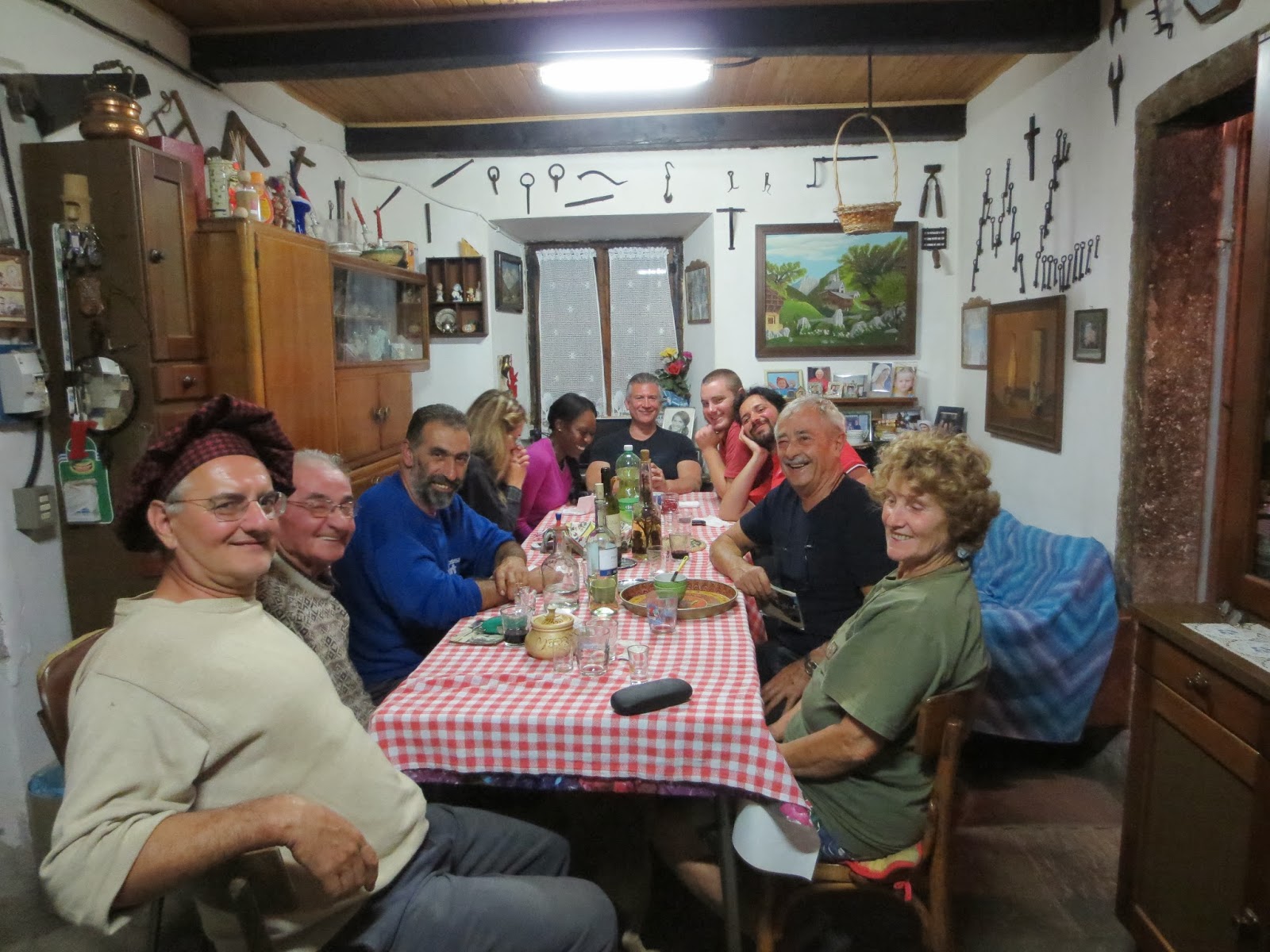
We dream of our village as a place where family can always gather.  To spend time working together, telling stories, sharing sadness and joy but also coming together.  We also home that this “family” extends to our friends who share the appreciation for the simple joy of a good meal, hard work and good conversation.

The connection to the earth is essential to grounding us.  I read once somewhere that you are supposed to stand in bare feet in the dirt at least 12 minutes per day.  Somehow that is somehow reconnecting us to mother earth.  Well, I am not sure about that but I do know that surrounding yourself with trees and rocks and gardens with rich, clean soil is soul and body enriching experience.

We are now acutely aware of the benefits of local agriculture, clean and slow food and its preparation.  We have expanded our original land in Veglio to include new areas of farmland and also forest.  With the help of willing college students, we hope to begin the process of reclaiming the fields that have been overgrown over the past 50 years.

Yes, those are cows on the bridge
The forest will give us the wood that will be used to fuel all of the heat for our home including hot water.  We will have some emergency electric heat and propane, but as designed there are two large fireplaces, three wood stoves, the cooking stove that also provides hot water and then a wood fired hot water heater.

And we hope that time in the Village learning to garden and respect the land will translate back home.  More food on your own patch of land, maybe a few chickens and resisting the urge for the overprocessed.

Our ancestors are with us to teach us.  We don’t like to talk about death in our modern culture.  We worship new, young and fast.  But that completely ignores all of the love, hard work and learnings that have come before us.  In Veglio, we have likely 30 generations of our family history.  Our hope is that we can celebrate and learn from them but also reconsider how we are able to learn from the cultures of all parts of our family tree.  The Yupik Eskimo,  the Portuguese, the Irish, the Arabic. 

We will surround ourselves with pictures and furniture and recipes and crafts of our extended family and the ancestors that are somewhere.   And we hope that the stories and lessons will somehow be preserved.

Chouinard at Work
Learning to work with our hands in resourceful ways gives creative problem solving.   We have forgotten how to think about the practical, physical parts of our lives.  How to measure, fit, draw, lift, twist and cut.  We have deferred much of those things in search for “real work”.  With the loss of those skills inside and outside our houses, we have lost some of our imagination.

One of the most widely recognized business leader is the CEO of Patagonia, Yvon Chouinard.  He started his company with his hands in the blacksmith shop and today it is a $600 million firm.  He insists on each of his managers spending time in the shop to think about the physical process.  How to design and improve and not just how to find cheaper, faster ways.

The remoteness of our village and the ancient approach to the construction gives us an incredible opportunity to relearn practical skills.  We envision a summer school where these crafts can be taught, both for people interested in making a career of them but also for our family and other people who may want to incorporate them into everyday life.s
Finally, after 700 years...A SEPTIC TANK

Live simply to thrive in a complex world.  We do live in very difficult, complex times.  The predictable corporate path is no longer predictable and our children’s generation is struggling to make sense of a world where the old rules are broken.  I don’t know the answers but I do know saddling yourself with debt, divorce and jobs that choke the creativity and flexibility set you up for the trap. 

Complex times require agility and the ability to adapt.  Packing a huge burden, both financially and relationally is very difficult.    So once again, we hope that a life of growing some of your own food,  building with your own hands and putting family and friends at the middle not the edge will be our most important inheritance to leave.