Saturday, October 20, 2012

The Nobility of Work


The first time that my Italian nephew Andrea met my American nephew Harry, he asked him a question.  Harry, what do you build?  Not Harry, what do you drive,  how many facebook friends do you have, what do you do…but what is it that you build with your own hands?  Harry, who is a hard working, wonderful young man was taken aback.  He had probably never been asked such a question.  It seems that in the modern American version of success, we have risen about working with our hands. 

Andrea and Harry Enjoying a Well Deserved Rest
That somehow those Powerpoints or spreadsheets are the real work and that to get the soil under our fingers or the sawdust on our brow is beneath us.  I think on some level, this is a reflection of our greater economic challenges where we got so successful and could borrow so easily that we deferred the making of and the building of and the designing of to others.  Affluenza I think they call it! 

In the old village of Veglio that at its peak had 250 inhabitants, nearly everything that was needed was made by hand.  The milk that was turned into cheese, the grapes that were turned into wine...the vegetables and animals to last through the winter.  The grain and chestnuts milled and then crafted into dark, nutritious bread that was baked twice a week. 

The rocks that were gathered  from the fields and the mountainsides were crafted into the walls and the roof.  The larch and pine and chestnut trees became the floors, the beams and the furniture.  Everything had a purpose and the wise use of your hands could turn the land and resources into the essential things that are required for a good life.

Mama Tuna and Grandpa and Grandma McCoy
I firmly believe that this somehow connects us to the earth and as importantly to each other.  Working together to provide the most important elements of our life.  There is a huge movement across the US to put on the table what is grown on small, local farms.  Thousands of young people who only in the previous generation would have been mocked for doing so, are opting out of the corporate track to build productive, healthy family farms.   
Grandma Driving Her SUV

A similar appreciation is growing of building with more sustainable, readily available materials.  Less plastic, less concrete, less material that must be trucked from halfway around the world.   We collectively seem to be gravitating, if ever so slowly,  towards a place of balance between convenience and significance. 

My grandparents had a huge influence on my life.  They not only loved me but they taught me how to work and how to appreciate the simple joys that come from making a house and land a home.  I have fond memories of my then 75 year old grandmother plowing her garden or replacing the floor of her porch.  We saw the same thing in the rural parts of Italy as well.   People well into their 80’s with shovels and rakes, working their garden or cleaning up a patch of land.  With smiles and a sense of contentment on their faces. 


Andrea and Sal Using a 700 Year Old Technique
My hope that this will be not only part of our life as we continue to restore our Italian home, but also will be a legacy that we can leave for our children and grandchildren. That they can learn to tend the gardens, grapes and the orchards. To cut the brush from the creek so they too can see the old church from the terrace on a late Summer day.  And also learn the ancient crafts and share the same experience as their ancestors three hundred years earlier. 

Dinner in Veglio
To get a sense of the satisfaction that comes from turning your labor into a meal for your family or a glass of wine that can be shared with friends around a fire.  To experience this on the mountain for a few weeks during the year and then bring that back to their own homes wherever that may be.


Monday, June 18, 2012

Making a home on the mountain


It is has been a month and a week since we got back from our trip to Veglio.  It seems like ten years since we were there but at the same time, I have images in my head during each day in which we are still there. 

We had an unusual trip in some respects if we look through the lense of a traditional vacation, but in other respects it was a very good, meaningful visit.  It was our first steps towards being at home in the Valley. And being at home means that problems exist in every day and in every family.  But at the same time, it means that we are home in a familiar, comforting place that allows us to sink roots.

Being home sometimes means you spend days cleaning up things you would rather not clean up.  On this particular trip, we had both of my brothers, Linda, Jocelyn, our daughter Alex, Mark’s daughter Allyssa and Ken’s niece Shandley.  We arrived on a Friday and settled into Mario’s place down the hill in Oira. The plan was for a good, reconnecting dinner at the restaurant next door and then an early night to rest and hit the village first thing in the morning.

Late Spring Rain and a Full Creek
We woke up to the sounds of light rain coming through the valley.  Our first order of business was to clean out the parts of the property that had been long neglected or used for livestock “storage” which was code for old hay and manure from various species.  That meant one group, largely Ken and Allyssa took the rabbit merde in the upper room while the rest of us cleaned out the various cellars and other stables that were needed for temporary storage.  Every one of us had very mucky tasks that were made even messier by the constant drip of the late Spring rain as the clouds had gathered against the Alps. 

Just about the time we finished with the nasty tasks, Andrea came up with the plan to move some items that had been temporarily stored by one of the neighbors, Renato Balzarini(also the proud owner of the rabbits),  in our stable,  down the path and up some old stone steps to an attic owned by Renato.  With only some minor slipping and sliding, we worked for the better part of an hour carrying some small furniture, boxes and various other items that needed to be cleared from our little goat stable. 
Clearing the Garden Path

There was one particularly large piece of furniture, a credenza, that needed to makes its way up into the attic.  I grabbed the front end and Ken grabbed the back and with a groan and wheeze, we starting packing it down the path and started our way up the by now slippery stairs.  Ken’s boots were to the slimey point from the rain, the mud and the remaining rabbit droppings that were still keeping him company. 

Just about the time we were near the top of the stairs, I gave a final pull over the threshold to get the weight off of Ken who was a bit below me and by now stepping out on the top landing.  All of the sudden, I looked back and Ken disappeared off the landing and I heard a thud and a few inaudible words.  I started yelling for help and trying to take a few deep breathes, terrified on what I would find as I looked over the edge. 

Some of the Stairs are Not Yet OSHA Compliant!
Finally, I pushed the furniture up into the room and made my way to the edge of the stairs, looking down a full eight or nine feet.  Ken was not moving and had landed on his side and most worrying was not talking.  Climbing down, I was quickly joined by the rest of the ashen-faced family members.  Mark and I looked for punctures or evidence of a major injury or bleeding and fortunately found nothing.  Ken was by that time starting to talk and between the shivers was at once upset because he knew he was done for the week and nervous about his shoulder that he thought for certain was broken.

Meanwhile, Andrea was on the phone with his father who is a medical doctor arranging for a meeting at the hospital once we got Ken down off the mountain.  After some lifting and swearing, we got Ken to his feet and fashioned a temporary sling.  Andrea loaded him into his jeep and made the ten miles down the mountain and to Domodossola.  We anxiously waiting for several hours and finally got word that the break was clean and with proper care surgery may be optional. 

Attending Church the Day After the Fall...Just in Case
Over the next forty eight hours, arrangements were made to send Ken home through Geneva, which we did.  Upon his arrival, Kathryn whisked him up to UC Davis Medial Center where they validated the diagnosis, rewrapped him and set out on the plan of a surgery-free, but four month recovery. 

On this particular trip, we were planning to spend some of the days down the hill at Mario’s  and then some of the time at a restored house in Veglio owned by our distance cousin Maria Luisa and her boyfriend(of 18 years)Angelo.  Maria was looking forward to sharing her hospitality and cooking with all of us and before we drove Ken to Geneva, we spent Monday morning clearing brush and yet another stable(goats) before settling in for a wonderful lunch prepared by Maria Luisa.

It was with great joy that Ken was able to be at the table, wrapped like a mummy, but eating with one hand and even finishing his meal with a little grappa.  It was a bittersweet moment as he said goodbye to our hosts and our extended Italian family prematurely.
The Mummy Seems to Like Grappa

Linda and I returned from Geneva at 2 in the morning having taken the wrong train and getting stuck in our least favorite Swiss town of Brig.  But we arose at our scheduled time to have breakfast on the mountain and begin our work.

Finally, the rain had cleared and we all settled in for various tasks around the property punctuated by incredible meals served by Maria Luisa with various guests including stone masons, roofers, helpers, cousins, girlfriends.  Andrea had made a special request for some American bourbon and on more than one evening we sat around or rather in the ancient fireplace sipping and talking, planning  and playing cards. 

The ladies even took a quick overnight trip down to Florence and really enjoyed the shopping and art and food.  It gave Mark and I time to work with Andrea, Marco and Massimo on clearing the final rubble from the house and repairing the floors of the stables that will be used for storage.
GionPiero the Stone Mason Explaining the Ancient Arts


On this trip, we also had the opportunity to do some “normal” tasks such as grocery shopping, buying a wheelbarrow, going to the car wash, shopping for underwear and socks, cooking, finding some much needed ibuprofen and getting to know the Italian medical system.  Not exciting but it did give us a glimpse of what it may be like as we move from tourists visiting to establishing a real home with real Italian parts of our lives. 


So we are now in a new phase of our restoration project which is to get real about the cost, risks and effort it is going to take to bring our dream to life.  And, to try to figure out how to have our feet in two homes with all that entails.  How do we live part of the year in Italy, how do we deal with being away from family for several months at a time, how do we deal with working remotely or building a local Italian business.
Jocelyn and MariaLuisa Showing Language is No Barrier

We do not know the answers to these questions but the questions are in the back of my mind each day, each plane ride in the middle of the night, each quiet evening spent in a hotel room in New York or a stinky train from the middle of nowhere.  I am not alone in the thinking.  Ken especially with four months of time away from his day job has been exploring a eco-tourist business that can share our experiences and the local arts and craftsmanship.

Despite all the obstacles, the bumps, bruises and slings, we are more committed now to creating a new home.  Of creating a clear picture in our minds of the day we can all raise a glass on our new terrace that looks out upon the mountains.

Lunch Al Fresco at MariaLuisa's


But for now, it is time to get back on an airplane to pay for some more stone and beams…And to plan Veglio in Fall during the Harvest.  Shovels, picks and wheelbarrows await us for our new Septic Tank!

Sunday, March 11, 2012

Balancing and Packing


Fifty eight days until our next trip to the Mountain.  We received a long update from Andrea yesterday giving us many details of the work that has been completed this winter.  Two barns repaired, one wall, windows in the kitchen, new water lines and the purchase of two tons of roof stone as well as larch beams for the soon to be new roof on the main house.

Winter Work on the Stairwell
Progress for certain all thanks to our nephew Andrea.  I have mentioned him several times over the past year, but it bears repeating and also telling a bit more of his story.  Andrea is a remarkable young man.  His parents met while working the summer holidays at a mountain resort during their college years.

Both Giovanni(my cousin) and Mareka had deep Alpini roots.  They both valued education and college took them to Torino and Milano.  He a doctor and she a journalist, they initially settled in Milan as the center of cultural and economic power in Northern Italy.  Milan gave them nearly everything they could want in terms of restaurants, jobs, shopping, the opera to name just a few. 

But they also longed for the beauty of the mountains, the community of the small villages, the rich traditions and foods and simpler life that was their family’s for hundreds of years.  Like so many of us who came of age in the post-war era, it was the aspiration that was the default path.

Andrea is their only son and from the start a curious, very bright one.  As they tell the story, there was much debate around the kitchen table in Milan on the fork in the road between the city and the country.  Should they remain in the urban area where the finest schools in Italy and the world could be found?  Does it make sense to spend more time with the family in Preglia?  Jobs would be much harder to find in the mountains and even with a medical degree and additional training, economic success would not be assured.

In the end, they returned to the homes that had been built by each of their parents in the middle of the last century.  Giovanni became a trusted, country doctor who is often found in his little jeep driving through treacherous, winding mountain passes to see patients. Mareka has written and translated but also done many other jobs to help with the family including sewing and gardening.  It has been the path less taken but without them knowing, they have also been the curators of the lifestyle and traditions that had been passed on for generations.

Each time some of the American family has come to visit their roots,  they have taken time to share the stories over wine and the table overflowing with food from the three gardens that provides most of the fruits and vegetables they eat.

Andrea Putting Milano Polytechnic to Work
And now it is Andrea’s turn to face the decision of the fork.   He attended architectural school in Milan and completed graduate school in Germany last year.  His thesis was approved and he also took his State examination for his license in architecture.  And now the decision must be made to stay in the valley and pour his heart into the restoring of the villages or to leave and pursue a career in the major centers of Europe or beyond.

Striking a balance between community and commerce, simplicity and challenge, possessions and experience.  This is the struggle of modern life, at least it has been the case for me and many of my friends.   Technology was supposed to make it easier.  Just have an Internet connection and you could live wherever you choose.  That worked for a while until the reality of millions in India, Romania and China doing the same thing for 1/100 of the price.   Trade-offs must be made.

While the answers are different for each person and Andrea’s answer may be different than his father’s, there does seem to be some things you can do regardless.    Resist the temptation of debt and complexity that come too easily in the path of the City.  In the name of aspiration, we too often sign up for the lure of things that ultimately weight us down and remove our choices.

The Canova Art Colony(town where Grandma was born)
Find the time to remain curious and committed to a life of learning.  Avoid the danger of being isolated in a rural existence or overly worried and hurried in the urban setting.  Technology does make it possible to learn wherever and whenever.   In fact, there may be even an advantage to learning in the relative solitude that is found in the country.  Some of the great colleges of the American West or New England are tucked away in small towns.  Just down the road from Veglio there are two colonies that are growing as centers of traditional arts and crafts. 

My Grandmothers circa 1975
Draw the thread from your past.  Find out what drove your ancestors to do what they ultimately did.  Whether they left it all behind to chase a dream in Alaska or California or New Zealand or chose to build a better life where their grandparents lived.

This is ultimately the purpose of Veglio.  To make the strongest of connections to our ancestors and to also provide the place of beauty, quiet and learning.  That regardless of the paths chosen by our children or our children’s children there will always be a place to remind them of simple truths.


Wednesday, December 28, 2011

Listening to Stones


It has been over three months since I last wrote of Veglio.  My intention was to write more frequently and to put down some of the thoughts that I had during the last construction trip but modern life has interceded. 

My Office Looks to Flatiron
I have been on a very fast treadmill that started just two weeks after I returned from the Mountain in late September.  I have probably spent half the time in New York sprinting from meeting to meeting and dodging cars as I walked from Flat Iron to Midtown several times each day.  Not a day goes by though when I don’t return in mind and spirit, if not body to our little village on the side of the hill.

It is often hard to reconcile the pace of modern life with the calling of my ancestors and the lessons that I believe they are trying to teach me somehow.   Now that I am fifty I also think about the ticking of life’s clock.  Am I going to have time to enjoy the slower pace of life?  To learn how to make that polenta or salami or maybe even some wine?  Does the significance of my work matter and is it worth the wear and tear that thousands of air miles and late nights in hotels inevitably take.

During the September trip, we needed to remove all of the debris that fell down when a large part of the bedroom roof collapsed.  We estimated nearly 140,000 pounds of stone roof and wall were hauled by six hands and a three tired backs.  These stones were comprised of large foundation rocks, medium sized stones that were stacked one on top of the other for the walls and then finally the flat rocks that are the roofing materials. 

Our Starting Debris Pile--September 2011
The largest stones were probably over 150 pounds and were large rectangular blocks.  The roof pieces were two inches thick and measured three feet by two feet for the most part.  Since the roof collapsed three floors and a 30-foot long wall, we started with a very large pile of rubble.  We not only needed to move the rocks, but also it was important to sort then in various sizes and shapes so that they could be reused at the appropriate time when we rebuild that part of the house.

The first challenge I had to tackle was in my own head.  How was I going to move these rocks without injuring myself?  A couple of mind games were waging.  I had injured my right hamstring at Easter this year during a soccer match.  I had ripped some of the tendons off the bone and was in physical therapy for the summer.  When I had tried to lift something heavy earlier in the year, it was like a hot knife cutting into my groin so I was a bit hesitant to risk a re-injury.  The second battlefront was my recent 50th birthday and the limits that I was putting on myself.  

For the first halfday or so, I would only lift the small rocks and was reluctant to pick up the larger cornerstones that needed to be moved.  Gradually though, I started testing myself as I saw my nephew pick up the largest stones and raise them three feet onto the sorting pile. I was further encouraged when we were joined by Daniel who was all of 65 years old and walked with limp and a stooped back.  He, with proper technique, was lifting the largest of rocks with slow but deliberate movement. 

Daniel, Age 65, Schooled Me!
By the third day, my legs and back were stretched and working.  With my fears conquered and a little bit of technique, I was not only keeping up but causing the passer-bys to ask about this American who supposedly worked a deskjob.  It felt great, especially as we begin to see real progress.  Structures began to emerge from the debris.  

First, a staircase or scala that had lead up to the second story.  Then, with enough digging we could see the outline for the two of the cellars that were used to store the entire winter’s food and wine supply.  Finally, the large entrance that once was the primary access to the house.  All in all, the collapsed section had one been four bedrooms, three cellars and a courtyard.  With the existing damage, though, nothing more than the foundation, six crossbeams and the thousands of pounds of rock remained.

Staircase on Outside of Bedroom Floors
So what did I learn from the September trip?  More than once, my uninformed technique nearly caused a massive avalanche of stone until my nephew or cousin or Daniel would attempt to translate proper instructions.   So here are a few tips that I picked up that I think may even have relevance back home in Orange County or maybe even the concrete and stone jungle of New York.

Don’t try to get to the bottom of the pile too quickly.  As you can see from the picture below, the debris was formed like a giant hillside.  We started at the bottom of the hill to remove the rocks.  In my quest to reach the ground and pull all of the choicest stones out, I worked an entire morning digging at the base.  When my architect nephew came by, he was aghast.  I had left the weight of the upper section precariously unsupported by my efforts and was just a few stones away from pulling the entire massive weight of multiple tons down upon myself.  The weight needed to be distributed evenly at a slope.  Trying to get to the bottom of the foundation too early versus continuing to push the upper sections down was a near fatal mistake.

Andrea and the Rolling Stone
Let gravity do its work in bringing the stones to the proper storage area.  As I worked my way up the pile, I would lift and dig and pry large sections of stone free. Then, I would pick up 100 pounders and carry them down the hillside.  Especially after the sun began to bake us, it was exhausting and also dangerous as I struggled to maintain my footing on the walk down.  Again, Andrea introduced the concept of gravity to me!  Go all the way to the top and get the large rocks rolling down. They will move the other medium and small rocks and pick up momentum.  Sure enough, once I got them rolling they picked up speed and with a little steering would end up just a few yards from where I would them place them on storage pile.

Little rocks are just as important as the big ones.  While we saw great progress when we would lift out a three foot by one foot stone from the dirt and dust, we also needed to collect the smaller rubble stones.  All of the rocks in the house are handcut or more properly handsplit which means that no two are the same exact size.  Setting a level floor or wall means wedging little rocks into the spaces created from the larger stones.  Having a large collection of these rubble stones is essential in getting a structurally sound wall and for keeping out the elements.  Mortar in the way we would think of it, is not used as it destroys the rocks over time.  We took great care in sorting even the smallest of this “waste” rocks into their own areas that can then be used later.

Three Stories of Dry Stone--600 Years Old
Holding the walls together with the natural forces create the strongest bonds.  As I mentioned earlier, the “modern” technique of large amounts of mortar is discouraged in proper historical restoration.  The preferred method is take the extra time to find the best fit rocks and then wedge the smaller stones for balance and filling.  This ageless technique uses the weight of the stones and fitting to create bonds that can last thousands of years.  Think Machu Picchu or the Pyramids.  Had mortar been used, it would have long ago given way and in the process destroyed the rock with its acidic nature.

In a few days, I will oil up the treadmill and get back to my modern “proper” job.  The most exciting event coming up, though is our next trip to Veglio in early May.  All that stone we took out in September will be reassembled somehow into that 30 foot high wall.  Three brothers along with Linda, Jocelyn, Allyssa, Alex and perhaps a few younger backs will be charged with putting Humpty back together again.   I am sure we will learn a few more lessons about ourselves, our ancestors and our mountain.

Thursday, September 29, 2011

Lessons from the Forest


I just arrived home last night after spending ten days on the mountain.  We worked morning to night hauling, cleaning and assessing our restoration project.  Over the coming weeks, I will share with you experiences that happened while I was there. 

Italy in the Middle Ages
Fragmented and Dangerous
In the meantime though, I thought it would be helpful to share some history of the village.  When most people think of a house in Italy, images of the rolling hills of Tuscany or the city streets of Rome come into their minds.   This is about as far from Veglio as could be possible.

Veglio, which translates to “awaken”,  sits in the Ossola Valley which feeds into one of the major areas of the Italian Alps, Valle Di Formazza.  This part of Northern Italy was originally settled by the Celts before the birth of Christ and was characterized by small bands of very tough, hardy people who were known to fight and protect their lands against invaders. 

The natural remote landscapes isolated them from the traditional Roman Empire.  In fact, there is a valley just behind Veglio that is called the “No One” Valley because when the tax collectors came to visit, the villagers would send a few scouts out to greet them.  When the Roman collectors would ask who lived there, the locals would respond “no one”. 

As far as we can tell, Veglio was established around 1200 AD for its unique position of a bench halfway up the mountainside that has probably 100 acres of arable land that is exposed well to the sun and protected from the wind.   It also is out of range of the marauding bands that flourished in the Middle Ages.  Many villages marked the riversides below and a cartpath connected southern Italy with Switzerland. 

Ponte Maglio in the Valley
However, Veglio was high above the river separated by thick forests and a band of granite cliffs.  The only access into the village was by either a series of stone steps cut into the hillside or a winding trail of switchbacks.  The way up was by foot or by donkey.  This actually was the case until 1961 when the village was abandoned.  Only after the abandonment and the building of a mine on the mountain above, was a gravel road established about fifteen years ago.

At its peak, there were probably twenty families living in Veglio.  Structures consisted of several housing units adjoined, plus stables and barns either under the houses or in separate buildings.  All of the buildings were built using various stone and rocks from the valley plus larch and chestnut from the forests. 

These stones range from a few pounds to well over 150 pounds.  The only way to transport was by human power, either individual stones on the back or carried in tandem like a barrel.  Local legend has it that the women carried most of the stone so the men could continue to work on building or tending to the animals.  

My uncle tells of his memory as a twelve year old of bringing a 60-pound pack of supplies up the nearly two hundred steps from the valley floor in about twenty minutes. 
A traditional "toilet"

In fact, the school that emerged only around 1800 was a mile and a half down the valley.  Children would walk down the path to school which normally only covered three or four years formally with some religious and secular education continued at home. 

Life continued remarkably the same for much of the active 900 years of its traditional existence from the late middle ages until the local municipality declared the village abandoned in 1961 due to its unwillingness to invest in the road necessary to provide what was then minimal services.

The essence of the village was one of cooperation towards the goal of subsistence.  If it existed in the late 1960’s in California, you would call them hippies living in a commune.  

There were two community bread ovens where the women gathered once a week to bake.  Laundry consisted of a long stone trough divided in three sections that still is in use.  Milk from the cowherds where brought to a creamery that converted the liquid into cheese that could be consumed and traded down the mountain.  Cheese and maybe some excess wine and apples were the only commodities that could be traded to acquire the few things that were needed from the outside.

Vegetables and fruits of all kinds were raised and can still be found today in the fields.  When the New World imports of potatoes and corn arrived from Columbus, these crops became very important for food crops. 

For the “health” of the village, grapes and apples abounded and grew in the hot but short summer sun.  These were primarily turned into wine, grappa and cider.  Most of this was consumed there.  In fact, my great grandfather expanded the house we are restoring to ensure that the family could store all the wine, cheese and other supplies needed for the long winter. 

Nebbiolo Grapes circa 2011
According to the reliable source of Uncle Davida, the Senestraro clan produced 7000 liters of wine each year for their consumption.  Doing the math on the 20 or so people who lived in the house at any given time, that is roughly one liter per person per day in wine.  We will explore the importance and use of wine in a future entry, but you get a sense of the priority placed on this crop.

Animals were an integral part of the cycle of village life.  Cows and sheep for milk, rabbits and pigs mostly for meat and chickens for eggs.  These were supplemented by deer from the local forest and the occasional donkey that grew tired of the walk up the hill. 

In the summer, the grazing animals were taken up the valley to higher pastures, but fall brought cooler temperatures and the return of the livestock.  During the winter, they lived in the first floor of the house or the adjacent barns.  This allowed them to be tended and also benefit from the warmth of the fireplaces and people.

Subsistence living was focused on the absolute optimal usage of everything that was found on the mountain. 

The concept of garbage did not exist and even today, the water from the ancient sink flows to the garden and foodwaste makes its way to the potato fields.  Whey from the cheese process fed the pigs, manure from the animals went to the garden and grew the hay that would make it back to the cycle.

Since the forests are fairly thin in this part of the lower Alps, wood is a precious commodity used for heating and cooking.  The forests were searched for downed limbs and the few trees that could be selected for cutting.
Young girl's dress we found...

It is remarkable to spend time with my cousins who were raised on this mindset of total usage.  This past week, I tried to throw some apple peels in the garbage and was nearly gang tackled.  At our barbeque in the summer, I noticed Mareka stacking up left over rib bones and chicken parts that were scraped off the plates.  When I asked why, she said she would separate them later with the larger pieces taken for the dogs. The smaller scraps and sharp bones would be left next to the forest to feed the foxes that kept the predator/prey balance in check.

These lessons of community and use of precious resources are intense and remind me of the losses that we have suffered in our “advanced” society that focuses on mindless consumption.

It also makes me think about the challenges endured by my family just to survive the winters and the work ethic required to build and maintain a family.  We found a dress in the house when we were cleaning.  It is probably 75 years old and close examination shows that it had been patched and repatched many times. 

Mareka is an expert seamstress and historian on the local garments.  She told the story that village wardrobes were quite simple.  Women would have two dresses.  A black one that would be their formal attire for their own wedding, church, funerals and festivals. Then, another one such as in the picture that would be worn each day and washed perhaps once a week. 

The trail to California
The immense contrast with our life in Orange County is often hard to reconcile but I know that Veglio is trying to teach me its important lessons.  The last few days I was in Italy, I decided to park my car at the bottom of the hill and hike up the path, through the forest and arriving at the village to work.

I stopped on the last day midway on the trail to think about my grandfather who would in 1921 put a pack on his back and hike down that trail to catch a train that lead to a boat that took him half way around the world.  

Could he ever have imagined how life in California would be?

Wednesday, August 17, 2011

Songs and Bombs


No, I am not writing about the latest chart topping single in Rome.  Nor will I make some social commentary about unrest in London or North Africa.    Rather I wanted to share with you a couple of strange occurrences in Veglio. 

One that brought tears to most everyone who was present.  The other that quite frankly scared the living merda out of us. 

It seems like music has always been an important part of life in Italy.  Whether the echos of songs through a church, an opera sung by Pavarotti or the strings in quartet by Vivaldi, music seems to be woven through the culture.

I remember that growing up there always seemed to be music around the big Italian family gatherings.  Most of the time, there would be Lindy Mantova on his accordion adding a melody to the wine, food and chatter that was a strange cross between something that resembled the English and Italian…Italish?

The Church at Tocino--3 Miles from Veglio
Our family in Ossola also have art and music as staples of their daily lives.  Andrea and his father, Giovanni belong to a chorale group of men that travel throughout Switzerland and Northern Italy.    They often perform songs that are several centuries old in little churches that predate another famous Italian’s first journey to America.  

We had heard that they were quite good, but never had experienced the music first hand.  That was, until our reunion in Veglio.

Due to predicted rain, the planned picnic had to scramble looking for cover.  Andrea was able to talk to the local priest about using the little church in Veglio.  The church itself probably seated no more than 40 or 50 faithful on those long ago Sundays.  That meant everyone without exception in village took time from their toils to celebrate mass and spend some time with their neighbors.

The Old Veglio Church
Built around 1200 AD, as of late it has been used more for storage than sacrament with chairs, boxes, refrigerators and other assorted material had to be moved out so tables for dining could be placed. 

Lunch was a raucous affair, with nearly 60 people enjoying lots of wine, polenta, chicken, ribs, lamb and assorted accompaniments.   Laughter and more than a little shouting rang through the church during the celebration.

Then…something quite strange happened.  From the corner table near the back of the church, singing began.  Not just any singing, but hair standing up on the back of your neck sounds of the chorale.  No instruments, just the joining together of voices in sacred music that was first sung over five hundred years earlier. 

What was once loud, became eerily still as the singing continued.  A little taste of the singing is in this video clip that we took with our iphone. 


Flash forward though to last Friday.  Not sure why I thought I needed it, but found myself taking a little early evening nap on the cabana.  When I woke up, I checked my phone and found a flurry of texts, attempted calls and voicemals from both daughter Alexandra and brother Mark.

Turning first to Alex,  she reported having been robbed near her new apartment in Chicago.  Fortunately,  only her wallet was taken, snatched while she was checking her groceries as she left the store. 

Next, I checked the voicemail from Mark.  ACCIDENT IN VEGLIO, check your email right away and call me back!  Holy crap, what is going on?

A quick check of my email reported the accident.  Andrea and Cecilia had been cleaning debris from the house the previous Monday.  A fire had been started to burn what they could.  Unfortunately, something found its way to the fireplace that caused an intense explosion. 

Andrea was no more than ten feet from the fire, while Cecilia was across the room.   The explosion knocked them both to the ground and shattered bottles nearby.  Andrea was hit the hardest, with his face blackened and hair and beard burning.

As soon as he could, Andrea made his way to the water trough instinctively submersing his face trying to stem the burning.  Neighbors came running having at first thought the sound was from the quarry, perhaps placing too much explosive.

Andrea with all his hair and his California Girls
A friend was called and brought Andrea and Cecilia to the hospital.  Andrea was injured most severely and had to stay for nearly a week.  The burns thankfully appear to be healing nicely thanks to quick action and good care. 

Of greater concern are his ears.  The hearing in both is not good and certain ranges are missing altogether.  Andrea is going to a clinic the next two weeks for hyperbaric care for the ear drums.  Hopefully, it will restore some if not all of the hearing that was lost.

Now that the mortal danger is past, we are hopeful that his hearing will return in full.  We know that he gets great joy in singing and listening to music.  It would be quite sad and listening to the chorale sing may give you an appreciation of this.

Rendering of the "Culprit"
Oh, I almost forgot.  Closer inspection revealed the culprit as a Bomba a Mano which translates quite clearly to hand grenade. Model #35 made between 1939 and 1945 was probably hidden away during the resistance fighting that occurred against the Germans during World War II.  Part of the Ossola Rebellion whose tale will have to wait to another time.

For now, we pray and hope for recovery.  Mark and I plan to be in Veglio the last half of September.  We will be working with Andrea to stabilize the roof and prepare the project for the Alpine winter. 

Don’t tell our mother this story as she will hound us daily. 


Wednesday, August 3, 2011

Old and New Friends & Family

We have been back now a week from Italy.   The jetlag is wearing off and the gelato-induced daze is starting to lessen.  Linda and I find ourselves asking “what the heck just happened” a few times a day.   We had an incredible time with a wide range of emotions and experiences over the past few weeks.

CaliItalia Family Portrait in the "New" Kitchen
My heart is also heavy as I write this, having learned of the passing of the eighteen-year son of one of my best friends.   I wanted to share some thoughts on our trip to Veglio though while the memories are still fresh in my mind.  Thoughts not so much of the old stones and wood and rubble, but of hearts and minds.  Of the reminders that life is both incredibly fleeting but also ties us together eternally if we let it.

During our trip, we had the opportunity to meet and spend time with many of our family who we had not met before.  Without exception, they welcomed us with open arms and a few kisses on the cheek like we had know them our entire lives.   

A little language barrier didn't stop Alexis and Meghan!
But even beyond our family, those we came in contact with in the little villages of the Ossola Valley were gracious and took time to listen and talk with us.   So, for this entry I thought I would make a few introductions of our extended Veglio family.

Our closest family in the Valley has always been Giovanni, Mareka and Andrea Scotton.  Giovanni is the grandson of my grandfather’s sister.  He and Mareka live in in the “new” family house built in the 1930’s next to the “new” church built in 1650.  Their son Andrea, who has just graduated with his master’s degree in Architecture and Planning is our partner in the restoration project. 

Mark, Mareka, Giovanni, Ken and Short Brother
I am sure we will be talking more about the Scotton family in the future.  Not only did we spend several days exploring the region with them, they organized our reunion lunch and worked so hard to ensure it was a great success.

On our last trip to Italy, we met Aunt Andrina.  She had also visited us in California twenty years ago and her joyful spirit is contagious.  Aunt Andrina worked nonstop for five hours in cooking, serving and cleaning up our Veglio lunch.  She lives in the new family house too, and can often be seen on her bicycle going to the market.  Not bad for nearly eighty, and we treasured the wisdom that she shared with us.

Aunt Andrina(on left)
Although Veglio today is home to just a few part-time residents, several of the locals have “getaways” there where they spend time with the gardens or making wine.  Cousin Davida has a house just down the path from our home.  This is his official man cave and he is the official winemaker of Veglio.  While we really like Davida, we are thinking of suggesting a few technical changes from California.  My neice Allyssa did have the pleasure of tasting it on this trip…I think she described it as “rustic”.
Napa Valley in no imminent danger

Sidenote:  As we were looking at our old house, we discovered a basement that we did not know about.  It contains a little winery with four giant barrels and room to store several hundred bottles. 

Ossola Valley is the start of several other valleys that make their way into Switzerland in this part of Italy.  Veglio is just one of a hundred little villages in Val Formazza.  Formazza has strong Germanic roots from the settling of Walsers which were a tribe that came to the region about a thousand years ago.  It is a major producer of hydroelectric power, granite and bottled water. 

The region is a complex mix of very old plus a new group of “settlers” from across Europe who are discovering its unique way of life and beauty.  We met a few of these recent immigrants to Formazza.  Like us, they have fallen for the area’s incredible beauty and availability of old stone houses.  Freddie is an artist from Basel, Switzerland who spends time here with his children, his art and his restoration project.

Freddie enjoys the music after lunch(and wine)
Cecilia is an art curator from Beirut who is restoring two old homes in Oira, which is just down the road from Veglio.  We spent time with her celebrating Andrea’s graduation plus at the reunion lunch.  She shares the view that there is something quite special to be rebuilt and given to those interested in learning from the past.

One of our special guides on the trip was Adrianna who is half American and half Swiss but has lived in Italy for most of her life.  “Addie” spent an entire day with us as our interpreter in working with the notary public as well in hiking up to Veglio to understand the village better.  

Adrianna and beau
She is a delight and was full of questions for Linda about life in the US.    She misses Cinnamon gum and US beauty products and wanted to hear all about the latest from Bloomingdales.  Adrianna is in the process of learning her fifth language, Japanese and has a very bright future wherever she decides to go!

While it is impossible to write about all of the people we met, there was one special little lady that I must mention.  For most of the past several years, we have been getting to know family from my grandfather’s side.  We really didn’t know too much about our grandmother’s family even though we knew she lived somewhere in the Formazza region. 

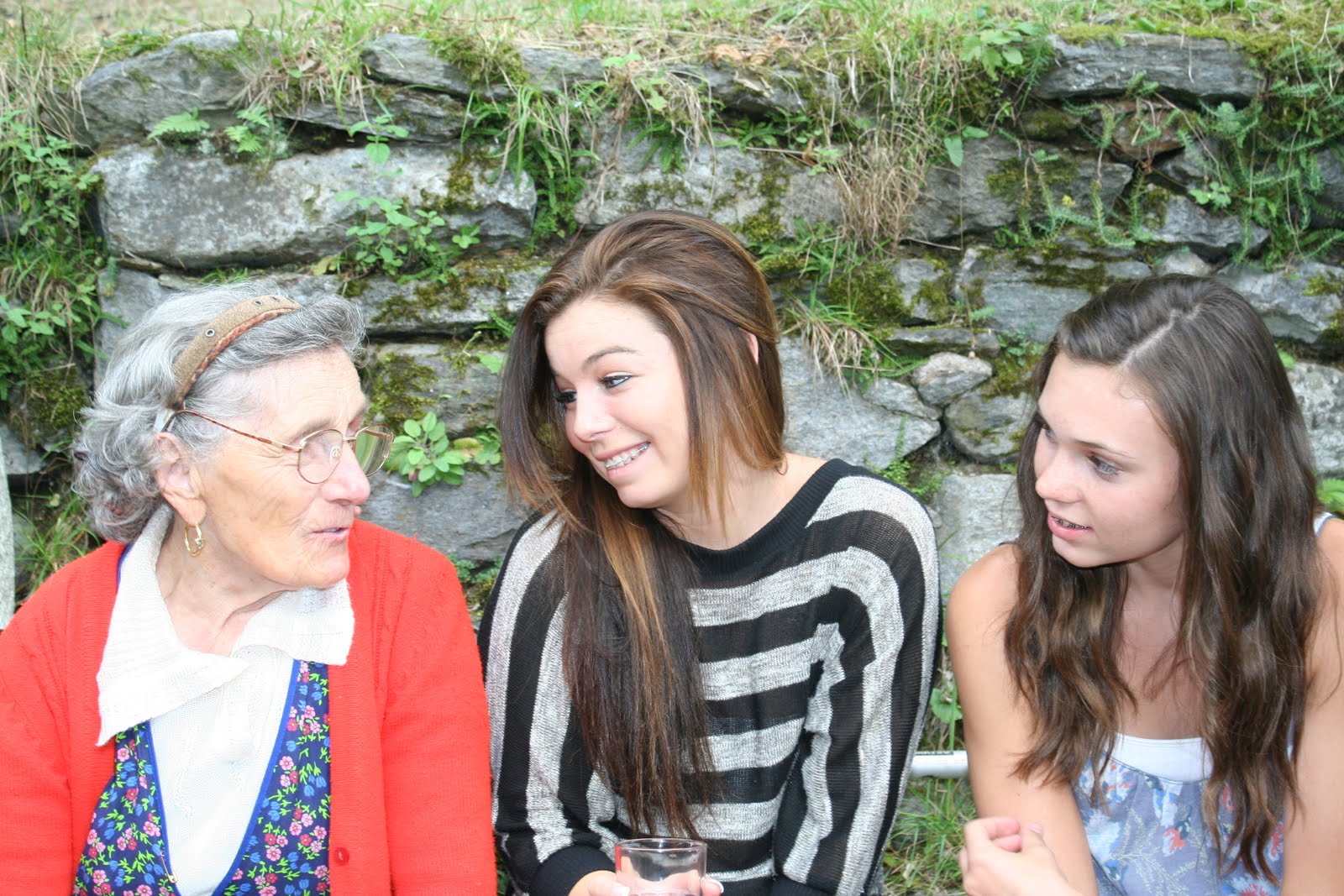
Aunt Paurina and her new great great nieces
When brother Ken was making reservations at a little B&B near Veglio, the proprietor(Mario) started asking questions about our family connections.  Ken told him about Grandma including her last name of Arrizzi.  A few days later, Mario emailed Ken to tell him that he had found one of Mama Tuna’s relatives living nearby.  It turned out to be her baby sister, Paurina, who is now 87 years old.

My mother remembers clearly her mother talking about taking care of this little baby sister who is nearly twenty years younger.  What a joy she was.  We had the chance to spend time at her home and she joined us for the entire day of the reunion.  Amazing to make a connection with a generation that we had thought was long gone.

Ken may still be on the Mountain
I am finding it very difficult to remain with my head in California.  Each day, I keep thinking about our experiences and the people of Veglio.  Even though, our trip and our time there was a once in a lifetime experience, my hope is that we continue to build these relationships as we rebuild the house.

But for now, I am back to the so-called real world of Orange County.